Arya News - The landmark law—the first of its kind in the world—kicked in on Wednesday.
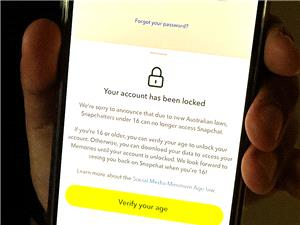
A 13-year-old boy displays a message on his mobile phone from social media platform Snapchat after his account was locked for age verification in Sydney on December 9, 2025. Credit - AFP/Getty Images
Kids in Australia will no longer be able to have accounts on social media apps like Instagram, TikTok, and Snapchat as Australia’s under-16 social media ban kicks in Wednesday.
The new law, which was passed by parliament in 2024, intends to shield children from harmful online content and addictive algorithms, as well as reduce cyberbullying and grooming. It comes amid rising suicide and self-harm rates among Gen-Z Australians.
“This is the day when Australian families are taking back power from these big tech companies. They are asserting the right of kids to be kids and for parents to have greater peace of mind,” Prime Minister Anthony Albanese told ABC on Wednesday.
The typical minimum age to make an account on most social media platforms is 13, though historically there’s been little enforcement. Around 80% of children in Australia aged 8 to 12 used at least one social media platform in 2024, equivalent to more than one million underaged users, according to Australia’s eSafety commissioner . That rises to 95% for teens between the ages of 13 and 15 who have at least one social media account.
The legislation—widely described as a “world-first” blanket ban—has inspired a number of other countries to consider similar restrictions on youth social media access. It represents a growing momentum to get to grips with a slew of social problems that are attributed to excessive social media use—from self image issues to sexual exploitation to phone addiction. But it may also mean cutting youth off from an important source of information, outlet for self-expression, and online community.
Tech companies are also watching the ban closely to see if others follow in Australia’s footsteps, which would mean potentially losing a significant share of users.
“Social media has a purpose but they should also be able to have a duty of care to Australian kids online, and that’s what these laws will do,” Minister for Communications Anika Wells said in a September interview with CNN. “Ultimately we want to get them off the screens, back onto the footy pitch or back into an art class or interacting with each other in real life.”
Here’s everything you need to know about the ban.
How the ban works
The ban applies to ten social media platforms: Instagram, Facebook, Threads, Snapchat, TikTok, YouTube, X, Reddit, Twitch, and Kick. The affected platforms were selected because their “sole or a significant purpose is to enable online social interaction,” eSafety commissioner Julie Inman Grant said. She also said her office prioritized platforms with the largest number of under-16 users, although the government can update the banned list to include others.
There are “200,000 TikTok accounts, 440,000 Snapchat accounts, around about 150,000 on Facebook and 350,000 on Instagram held by kids between 13 and 15 years old,” Albanese told ABC on Wednesday.
Kids under 16 will no longer be allowed to make new accounts or access their existing ones on these platforms. Without an account, kids may still be able to see content on some social media platforms like YouTube, but they will not be able to post, comment, or message other users.
The ban applies to people who are “ordinarily a resident of Australia.” Users who visit Australia for less than 200 days out of the previous 12 months will likely not be affected.
The affected platforms are required to take “reasonable steps” to comply with the law, although they have some discretion over what those steps might look like. Platforms will likely take a number of approaches towards verifying the age of users in addition to asking for their date of birth—which is a typical step when making a social media account. These can include requiring users to submit an official document with proof of age, using biometric data to estimate a user’s age (such as through live video selfies), and reviewing online behavior (like browsing history and social networks).
Many of these age checks are not airtight. Already, several under-16 users told ABC that they have been able to get around age verification or have not had their accounts removed. One parent told ABC their 13-year-old son was able to pass the biometric face scan “by hiding his teeth and scrunching up his face.”
But underage users won’t be breaking the new ban and won’t face penalties; rather, the platforms that let them will be. Companies found to breach the law could face fines as high as A$49.5 million ($32 million).
Why Australia introduced the ban
The push for a nationwide ban began last year, after some states in Australia began implementing their own regulations and a campaign called “Let Them Be Kids” urged greater protections for children on social media. The campaign was launched by newspaper publisher News Corp. alongside parents across Australia and child safety advocates. One article from the campaign detailed the stories of kids who had died by suicide linked to online causes. A petition attached to the campaign calling on the government to raise the minimum age of access to 16 was signed by more than 54,000 people.
The campaign was backed by Peter Dutton , then-leader of the opposition, and soon Albanese took up the charge with his own campaign called “36 months,” alongside radio host Wippa, that advocated for the minimum age to be raised from 13 to 16. The government led by Albanese pushed the legislation through parliament by the end of November—a move that was criticized by some as being a rushed attempt to wrangle a potential key issue in the lead up to May elections.
“Governments have a responsibility to set a framework, the laws in which society is indicating what society thinks is right, and in this case, what we think is right is that parents need to be empowered and children need to have a childhood,” Albanese told reporters at the United Nations in September.
At least one incident of deepfake image-based abuse occurs per week in Australian classrooms, according to Inman Grant. Social media addiction, screen time, and deceptive internet practices are also concerns. “With the manipulative algorithms, the dark patterns and the rabbit holes, it’s not really a fair fight,” Inman Grant told Bloomberg in February.
“It’s almost like the genie’s out of the bottle with the internet,” Wells said on CNN. “There’s a helplessness around what is actually still possible, but if government shows leadership, there is a possibility for us to still make tangible differences to save kids online.”
How companies are responding
The affected platforms have largely criticized the legislation, although they said they will comply.
“We believe strongly in the open internet and the continued accessibility of quality knowledge, information, resources, and community building for everyone, including young people,” Reddit said in a post on its site on Monday. “This is why Reddit has always been, and continues to be, available for anyone to read even if they don’t have an account.
“By limiting account eligibility and putting identity tests on internet usage, this law undermines everyone’s right to both free expression and privacy, as well as account-specific protections,” the company continued.
Several of the companies also said they already have online safety features to protect children. Some companies have also argued that the law is not realistic when it comes to age assurance technology, Inman Grant told Bloomberg.
Still, all of the platforms have already begun to adapt to the ban.
Reddit said it will use a new “privacy-preserving model” to predict whether users are under 16 and ask them to verify their age. In addition to complying with the requirements of the law, Reddit said it is voluntarily launching a version of Reddit globally with added safety features that will be mandatory for under-18 users. These include stricter chat settings, restrictions on personalized and sensitive ads, and a block on adult content.
Meta already began removing under-16 users from Facebook, Instagram, and Threads on Dec. 4. Users can reactivate their account when they turn 16, and their data will be stored until then or it can be downloaded ahead of the ban.
Snapchat is suspending accounts for under-16 users for three years or until they turn 16.
YouTube is automatically signing under-16 users out of their accounts on Wednesday and hiding their channels, but it will store their data so that they can reactivate their accounts when they are 16.
TikTok is deactivating all accounts held by under-16 users. The company said it will use age verification technology to determine who uses the account, regardless of the email or name associated with it. It will also hide from visibility content posted by young users.
Twitch, a live-streaming service, said under-16s would not be able to create a new account from Dec. 10, but it would only deactivate existing under-16 accounts from Jan. 9.
Kick, also a live-streaming platform, said it will verify users’ ages through a mandatory “k-ID system” and “layered age assurance methods.” Accounts held by Australians under 16 will be deactivated “with care and clear communication,” the company said.
X, which has been one of the most vocal opponents to the ban on the basis of free speech, said at the last minute that it will comply with the ban. It said it would take a “multi-faceted” approach, including using self-attested age, identification documents, account creation date, and email addresses to determine the age of an account. The data used for verification will be destroyed within 31 days, the platform said.
“It’s not our choice – it’s what the Australian law requires,” X said on its website .
How users are responding
The legislation has received a wealth of support from the Australian public, including both parents and children. The law had the support of 77% of Australians surveyed around the time that it passed last year.
But the law remains controversial. Some users shared that the ban would disproportionately affect children from marginalized backgrounds, including those who live in remote areas, identify as queer, or are not native English speakers. These kids could lose out on an online community of friends or support that they are unable to find in person. The Centre for Multicultural Youth , an Australian non-profit that consulted youth and their families about the ban, said the ban could negatively impact mental health and a sense of belonging among youth, and could limit access to information.
Some groups have also raised concerns about how age verification checks will maintain privacy, especially if they use identification documents or biometric data. A government-commissioned Age Assurance Technology Trial carried out in June found that age checks can be “private, robust and effective.” It also concluded that technology did not pose a barrier to these checks, despite arguments from some companies.
People have also raised concerns that platforms like 4Chan are exempt from the ban, despite being associated with less regulated and at times harmful content, and some worry that banning more “mainstream” social media platforms will encourage young people to seek out alternative social media sites that may be less regulated and more dangerous.
The Australian regulator shared a list of online platforms that are not subject to the ban: Discord, GitHub, LEGO Play, Roblox, Steam and Steam Chat, Google Classroom, Messenger, WhatsApp and YouTube Kids. But the government can also update the list of platforms affected by the ban under the legislation.
As the ban sets in, young users appear to have gravitated towards alternative platforms. Lemon8, ByteDance’s video and photo sharing “sister” app to TikTok, was the most downloaded free app on the Apple App Store in Australia on Wednesday, according to Bloomberg . Yope, a friends-only photo sharing platform, said it gained 100,000 new Australian users by word of mouth in the lead-up to the ban. After the eSafety commissioner put both platforms on notice , Lemon8 said it plans to comply with Australia’s laws.
Some youth may also turn to virtual private networks (VPNs), which hide a user’s IP address and online activity allowing them to bypass geographic restrictions. But the government is confident that platforms will be able to prevent users from using a VPN to circumvent the ban.
“These social media platforms have so much data on us because we choose to give it to them because we like social media,” Wells told ABC on Wednesday. She added that using an older person to scan their face to get around biometric checks will not work forever.
“We think it was too important for us not to have a crack at this, even if we’re the first to do it,” Wells said on CNN, “and even if it’s not perfect, it’s too important not to try and make a meaningful difference.”
Where else social media is being banned for teens
While Australia’s blanket ban is the first of its kind in the world, a number of other countries have implemented laws aimed at addressing online safety for children, and several more are now weighing more restrictive bans like Australia’s.
Earlier this year, crowds of people took to the streets in Nepal to protest against corruption and a lack of political accountability after the government rolled out a nationwide ban on several major social media platforms.
In May, New Zealand proposed a ban on under-16 social media accounts, which would follow a similar age verification process as Australia’s if legislated. In November, Malaysia said it will ban under-16 social media users beginning next year. Indonesia is similarly weighing minimum age restrictions for social media. And Singapore, which has discussed the issue with Australia , is banning the use of smartphones and smartwatches in secondary schools, including during recess and after school activities. One town in Japan has even introduced a recommended two-hour daily limit on recreational smartphone use for all residents, regardless of age.
In November, Denmark proposed a social media ban for kids under 15 with exemptions for kids as young as 13 who have parental consent to access certain platforms. Several other European countries, including Italy, France, and Germany, as well as some U.S. states also require parental consent for children below a certain age to sign up for social media accounts.
“Since the announcement of Australia"s landmark minimum age law, I have been watching closely. And I have been inspired by Australia’s example,” President of the European Commission Ursula von der Leyen said in September. “Firstly, that you are the first to give this a try. And that when your loud critics tell you ‘this will not work,’ ‘that it cannot be done,’ ‘that the tech genie cannot be put back in the bottle,’ you are persisting.”
Contact us at letters@time.com .