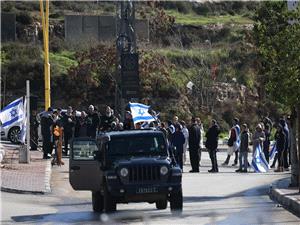
Arya News - Israel’s decision to formalise 19 so-called settlement outposts raises further fears for future of occupied territory.
A new wave of Israeli policies is changing the reality and boundaries on the ground in the occupied West Bank.
The Israeli government has approved the formalisation of 19 so-called settlement outposts as independent settlements in the occupied West Bank. This is the third wave of such formalisations this year by the government, which considers settlement expansion and annexation a top priority. During an earlier ceremony of formalisation, Finance Minister Bezalel Smotrich said, “We are advancing de facto sovereignty on the ground to prevent any possibility of establishing an Arab state in [the West Bank].”
Settlement outposts, which are illegal under international law, are set up by a small group of settlers without prior government authorisation. This does not mean that the settlers, who are often more ideological and violent, do not enjoy government protection. Israeli human rights organisations say that settlers in these so-called outposts enjoy protection, electricity and other services from the Israeli army. The formalisation opens the door to additional government funds, infrastructure and expansion.
Many of the settlement outposts formalised in this latest decision are concentrated in the northeastern part of the West Bank, an area that traditionally has had very little settlement activity. They also include the formalisation of two outposts evacuated in 2005 by the government of Israeli then-Prime Minister Ariel Sharon.
While these government decisions may seem bureaucratic, they are in fact strategic in nature. They support the more ideological and often more violent settlers entrenching their presence and taking over yet more Palestinian land, and becoming more brazen in their attacks against Palestinians, which are unprecedented in scope and effect.
The Israeli human rights organisation B’Tselem estimates that settler attacks against Palestinians have forcibly displaced 44 communities across the West Bank in the past two years. These arson attacks, vandalism, physical assault and deadly shootings are done under the protection of Israeli soldiers. During these settler attacks, 34 Palestinians were killed, including three children. None of the perpetrators has been brought to justice. In fact, policing of these groups has dropped under the direction of Israel’s national security minister, Itamar Ben-Gvir, who is a settler himself.
United Nations Secretary-General Antonio Guterres recently sounded the alarm about Israel’s record-breaking expansion of illegal settlements in the West Bank and the unprecedented levels of state-backed settler violence. In a briefing to the UN Security Council, Guterres reminded states that all settlements are illegal under international law. He also warned that they erode Palestinian rights recognised under this law, including to a state of their own.
In September, United States President Donald Trump said he “will not allow” Israel to annex the West Bank, without offering details of what actions he would take to prevent such a move.
But Israel is undeterred. The government continues to pursue its agenda of land grab, territorial expansion and annexation by a myriad of measures that fragment, dispossess and isolate Palestinians in the West Bank, including East Jerusalem, and continues its genocidal violence in Gaza.
More than 32,000 Palestinians have been forcibly displaced from their homes in three refugee camps in the occupied West Bank for nearly a year. The Israeli army continues to occupy Nur Shams , Tulkarem and Jenin refugee camps and ban residents from returning. Meanwhile, Israeli forces have demolished and damaged 1,460 buildings in those camps, according to a preliminary UN estimate. This huge, destructive campaign has changed the geography of the camps and plunged more families into economic and social despair.
This is the state hundreds of thousands of Palestinians across the West Bank find themselves in because of Israeli restrictions, home demolitions and land grabs. The Israeli army has set up close to 1,000 gates across the West Bank, turning communities into open-air prisons. This has a direct and devastating effect on the social fabric, economy and vitality of these communities, which live on land that is grabbed from under them to execute the expansion of illegal settlements, roads and so-called buffer zones around them.
According to the UN Conference on Trade and Development, Israeli practices and policies over the past two years have cost the Palestinian people 69 years of development. The organisation recently reported that the Palestinian gross domestic product (GDP) has shrunk to 2010 levels. This is visible most starkly in Gaza, but it is palpable in the West Bank as well.
The results of these policies and this reality are Palestinians leaving their homes and Israel expanding. During the summer, Israeli Prime Minister Benjamin Netanyahu told a local news station he was on a “historic and spiritual mission”, in reference to the vision of the Greater Israel that he said he was “very” attached to.