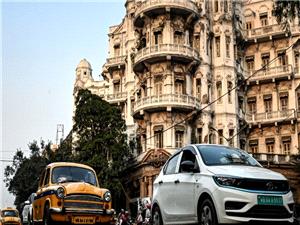
Arya News - India’s electric vehicle market, long dismissed as aspirational rather than imminent, is finally gathering speed.
NEW DELHI – On India’s crowded city streets, where the air often hangs heavy with exhaust and impatience, a quiet shift is under way.
Scooters glide past traffic lights without a growl. Three-wheeled rickshaws hum instead of sputter. And in bus depots from Delhi to Bengaluru, charging cables now snake across the ground where diesel hoses once lay.
India’s electric vehicle market, long dismissed as aspirational rather than imminent, is finally gathering speed.
In financial year 2024-2025 alone, the country sold more than 2 million electric vehicles, according to industry estimates.
There are now now nearly 6.5 million EVs on Indian roads, a milestone that would have seemed improbable just a few years ago.
Sales in the April–June 2025 quarter rose 34 percent from a year earlier, capturing about 8 percent of the overall vehicle sales.
Yet the story of India’s EV transition is not one of glossy electric sedans or luxury early adopters. It is a mass-market revolution, unfolding in two-wheelers, three-wheelers and city buses, the unglamorous but indispensable segment of urban mobility.
However we have to remember- This is really a market built on Mopeds and Rickshaws.
More than half of India’s electric vehicle sales come from two-wheelers, with battery-powered scooters and motorcycles increasingly favored by commuters navigating congested cities and rising fuel prices.
Another 36 percent of sales come from three-wheelers, a category in which India has quietly become a global leader in electrification.
In this segment, electric vehicles now account for more than 57 percent of all sales — a penetration rate unmatched in most large economies. For drivers of auto-rickshaws and delivery vehicles, the math is simple: electric vehicles cost less to run, require less maintenance and offer predictable daily economics.
Passenger cars, by contrast, remain a smaller piece of the jigsaw. Electric cars accounted for just 5 percent of car sales in 2025, up from earlier 2-4 percent cent.
This segment is led by domestic manufacturers like Tata Motors and Mahindra, alongside newer entrants such as MG Motor. High upfront costs and patchy charging infrastructure continue to restrain wider adoption.
Overall EV penetration across all categories reached nearly 7-8 percent. However this is way too short of the government’s goal of 30 per cent penetration by 2030.
Nevertheless, behind India’s EV push lies a confluence of urgency and opportunity.
India is the world’s third-largest emitter of greenhouse gases, and its cities regularly rank among the most polluted. Delhi the capital is right now experiencing extremely high AQI levels, which has forced the government to place a number of restrictions on construction and mobility.
Electrifying transport is seen not merely as a technological upgrade but as a public health intervention and hence, a cornerstone of the country’s net-zero aspirations.
The government has consequently leaned heavily into that logic with a series of subsidies, production-linked incentives and mandates for public procurement to help create scale.
Policymakers are targeting not only 30 percent electric vehicle penetration by 2030, but even more aggressive goals for buses and two- and three-wheelers.
If those targets are met, annual EV sales could potentially reach 17 million units by the end of the decade. And if indeed these targets can be achieved, the market could more than double in value to over $100 billion.
Nowhere is the economic case clearer than in public transport.
Electric buses, which now account for roughly one-fifth of new city bus orders, cost significantly less to operate.
Over a typical 12-year lifecycle, transport operators can save the equivalent of hundreds of thousands of dollars per bus. These savings could reshape procurement decisions in cash-strapped municipalities.
However, we have to realise that Infrastructure Gaps persist and optimism must come with caveats.
Charging infrastructure remains the system’s weakest link. While fast chargers and battery-swapping stations are expanding, coverage is uneven and reliability varies widely. For many drivers, especially outside major cities, range anxiety remains real.
Experts argue that longer battery range alone will not solve the problem. What India needs, they say, is density. A charging network that is visible, predictable and integrated into daily life.
That, in turn, requires coordination across government agencies, from land allocation and power supply to local permitting.
Battery supply chains present another vulnerability.
India remains dependent on imports for critical minerals.
The government of course has launched a national mission to secure minerals and build domestic manufacturing capacity, though results will take time.
If India’s EV transition succeeds, it is likely to do so through fleets rather than private garages.
Electric vehicles already dominate last-mile delivery, quick commerce and high-frequency urban travel, where predictable routes and centralized charging make electrification easier.
Logistics companies and ride-hailing platforms are emerging as powerful catalysts, ordering vehicles by the thousands rather than the dozen.
This focus on scale over status differentiates India from many Western EV markets — and may prove to be its advantage.
However, even as sales climb, awareness remains uneven. At a recent industry conference, executives pointed to Vietnam and Indonesia, where tens of thousands of salespeople are deployed solely to educate consumers about electric vehicles.
India, by contrast, has relied more on subsidies than storytelling.
The next phase of growth may depend on closing that gap — lowering battery costs, expanding charging networks and convincing millions of consumers that electric mobility is not just greener, but better.
For now, the hum on India’s roads is getting louder.
Whether it becomes the dominant sound of the next decade will depend not just on technology, but on policy, infrastructure and public trust and may be the hardest miles of the transition we seek.