Arya News - Special counsel team concludes former president’s main purpose was to seize power for himself.
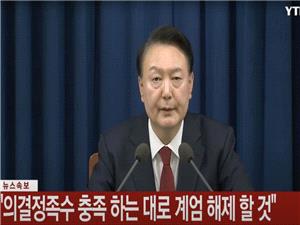
SEOUL – Former President Yoon Suk Yeol had prepared to declare martial law bid for over a year with a clear purpose to “eliminate the opposition and monopolize power,” the special counsel investigating Yoon’s alleged insurrection and treason concluded Monday.
Special counsel Cho Eun-suk’s team specified that Yoon began preparations for the Dec. 3, 2024, martial law imposition at least by October 2023, in a media briefing held at 10 a.m. that concluded its 180-day probe. Since taking office in 2022, Yoon had considered emergency martial law and kicked off preparations more than a year before declaring the country’s first martial law in some 40 years.
A total of 27 individuals have been indicted by Cho’s team in relation to Yoon’s short-lived martial law, including former members of Yoon’s Cabinet, such as ex-Prime Minister Han Duck-soo, ex-Finance Minister Choi Sang-mok, ex-Interior Minister Lee Sang-min, ex-Justice Minister Park Sang-jae, ex-Defense Minister Kim Yong-hyun and other prominent members related to the Yoon administration, including People Power Party Rep. Choo Kyung-ho.
Yoon, who had already been indicted for leading an insurrection and abuse of power before the launch of Cho’s team, was additionally indicted by the special counsel on charges of obstruction of justice, aiding an enemy and perjury.
“The investigation confirmed that (Yoon) made the declaration for the purpose of suspending political and National Assembly activities through military force, seizing control of legislative and judicial powers through an emergency legislative body, then eliminate those opposing him to monopolize and maintain power,” Cho said in the briefing.
In Yoon’s martial law decree, he banned all political activities, including the assembly of lawmakers, without the backing of law or the Constitution. The illegal nature of his martial law decree was one of the key factors in the Constitutional Court confirming Yoon’s impeachment and him being charged with insurrection in the ongoing criminal investigation.
According to the special counsel’s findings, Yoon moving the presidential office from Cheong Wa Dae to the current location in Yongsan-gu, central Seoul, the former premise for the Ministry of National Defense, played a key role in him and Kim Yong-hyun conspiring with military generals for martial law. The discussions they had laid the groundwork for personnel decisions for what would be the martial law command, including Park An-su, who was then the Army chief of staff.
The probe into Yoon also confirmed suspicions that the man who was then leader of South Korea attempted to induce military provocation from North Korea, which Cho said only failed when the North did not respond with military action. This refers to the allegation that the Yoon administration sent drones to the North, which the drone commander of the time admitted was done under orders from the military.
“We have confirmed Yoon, Kim and (former Counterintelligence Commander) Yeo In-hyung conducted abnormal military operations in October 2024 to induce military actions from the North to acquire justification for the emergency martial law,” Cho said.
Cho said in order to justify martial law, Yoon, Kim and former and incumbent military generals under the Yoon administration labeled political activities of lawmakers as being “anti-state.”
During a meeting with People Power Party leadership on Nov. 25, 2022, months after being elected as president, Yoon openly expressed hostility toward the party’s rival Democratic Party of Korea.
“I have emergency powers. I will sweep them all away even if I get shot to death,” Yoon was quoted as saying in the meeting.
Yoon also reportedly ordered military commanders to arrest then-People Power Party leader Han Dong-hoon — who had been a longtime close confidant — on Oct. 1, 2024, and called him a “commie” in July of that year, according to the briefing.
“Through these facts, we can see that Yoon was not following his (sincere) beliefs, but tried to eliminate those opposing him via martial law by labeling them as anti-state powers,” Cho said.
The special counsel team said one of the motivations behind Yoon’s actions was to resolve risks from the investigation targeting his wife Kim Keon Hee. Kim is currently on criminal trial for a series of allegations, including bribery, stock manipulation and unauthorized interference with state affairs — suspicions of which had been swirling even when Yoon was president.
“We cannot say the ‘court risks’ of Kim Keon Hee were not motivation for (Yoon) declaring martial law,” said assistant special counsel Park Ji-young. “It appears that he believed that seizing all power would solve everything. … The main purpose of martial law was the monopolization of power, to do anything he wanted to do. We believe this included resolving court-related risks for himself and his wife.”
But Park pointed out that many of the criminal allegations against Kim had not surfaced by October 2023, as Yoon was making early preparations for martial law. Based on this, she said issues related to Kim were probably not the main factor leading Yoon to impose martial law.
Park confirmed that the former first lady was found not to have played a part in the emergency martial law.
The probe also found that Yoon had attempted to rig evidence to back his debunked claim that the 2024 parliamentary elections — in which the Democratic Party scored a resounding victory over Yoon’s People Power Party — had been rigged.
The special counsel has handled 215 cases related to the insurrection probe, targeting high-ranking government officials in the Yoon administration, top aides of his office, former and incumbent politicians and top-level military leaders at the time of martial law.