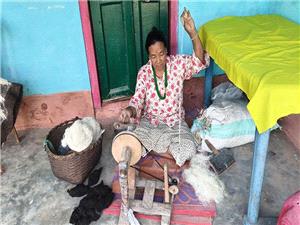
Arya News - Beyond production, wool mats hold a deep cultural value. Many residents believe wool retains warmth and helps relieve joint or back pain. In Hindu households, the wool mat is also an important part of marriage customs, gifted by the bride`s family to the groom during the ceremony.
SAMTSE – Upon entering homes in Shingdreygang, locally known as Jamirkot in Pemaling, guests are welcomed in a manner that has become uncommon in many parts of the country.
Instead of branded mattresses or decorative seating, visitors are offered a patterned wool mat to sit on, a practice that remains woven into daily life.
Weaving wool mats has been part of family routines for generations, with the skill quietly passed from one household to the next.
The work fits between farming and domestic chores, yet it continues to hold a central place in the community’s identity at a time when many rural crafts are disappearing.
More than 35 households in the Norgyeling–Shingdreygang chiwog are still involved in weaving, including 10 to 12 households in Nakiling (Niguray). Most weave only during limited hours outside the farm season, which restricts overall production.
The wool mats vary in size and purpose. A double-layered patterned mat, known as a manray butay, can cost up to Nu 10,000 or Nu 12,000 locally.
A single-layered mat, or gidray, which is lighter and quicker to weave, sells for around Nu 4,000. The price difference reflects the amount of wool and hours of labour required.
The process begins with hand-separating the wool, preparing the thread, setting up the loom, washing the wool, and finally labelling the finished product.
Washing alone involves lifting heavy, wet bundles, a task often supported by men due to the weight. The work is slow and repetitive, even experienced weavers complete only a few pieces a year.
Menu Maya Ghalley, 64, learned weaving from her parents, a skill common in almost every household during her childhood.
“Everyone used to weave at home, so I also learned it,” she said. Managing time, however, has become harder as farming demands grow.
Another resident, Sari Maya, weaves three to four wool mats a year and keeps five to six sheep, purchasing extra wool from local herders when she runs short.
Black wool, considered more expensive than white, now costs about Nu 400 for two kilogrammes.
A 33-year-old woman with over a decade of experience produces roughly four pairs of mats annually.
She supplies some to Thimphu and meets local demand, weaving only in the early mornings and evenings.
One of the major challenges the community faces is the absence of a formal support system. The craft has no experts to guide improvements, no structured training, and no mechanisms to enhance quality. Production relies entirely on traditional knowledge that has not been updated to meet external market requirements.
Without recognised standards, the wool mats cannot access larger markets, limiting the income the craft could generate.
Recently, the Royal Textile Academy has shown interest in the craft, and residents are exploring ways to introduce standards and certification. Many hope such efforts could eventually open new opportunities, although nothing concrete has yet taken shape.
Beyond production, wool mats hold deep cultural value. Many residents believe wool retains warmth and helps relieve joint or back pain.
In Hindu households, the wool mat is also an important part of marriage customs, gifted by the bride’s family to the groom during the ceremony.