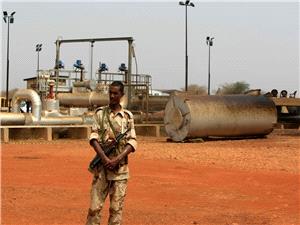
Arya News - RSF’s control of the Heglig oilfield means government has lost the most important oil facility in the country.
The Rapid Support Forces’ control of the Heglig oilfield means that the most important functioning oil facility in Sudan has fallen outside the control of the central government, with production halted and workers evacuated towards neighbouring South Sudan.
The importance of this event is not merely symbolic; Heglig is a strategic hub on three levels:
Economically:
The Heglig field processes between 80,000 and 100,000 barrels per day for the benefit of Sudan and South Sudan, and the pipeline to Port Sudan passes through it. This means that its loss delivers a direct blow to what remains of the Port Sudan government’s cash revenues – including fees from the transit of South Sudanese oil.
Militarily:
Heglig represents the last major strategic position for the army in West/South Kordofan after the fall of el-Fasher, the capital of Darfur, and Babnusa in West Kordofan. The army’s withdrawal from the field – even if justified as being for the “protection of facilities” – reflects a shift in the balance of power in the region in favour of the RSF and their allies.
Geopolitically:
The Heglig field is highly sensitive as it is part of a shared oil network with South Sudan. And historically, it has been a point of dispute between Khartoum and Juba (the 2012 crisis being an example). Now, it has become the subject of a new contention between Sudan’s army and the RSF, with a third harmed party being the government of Juba.
In this sense, the fall of Heglig will raise the cost of continuing the war for the government to an unprecedented level since April 2023, as it strikes at the last “economic pillar” on which the army’s authority in the east and north could rely.
A strategic shift, no end to the war in sight
From a politico-military perspective, the effect of losing the Heglig oilfield can be read in three overlapping directions:
First : strengthening the RSF’s ability to impose new negotiating realities. After the fall of el-Fasher in October, talk began that the RSF was working to consolidate a semi-autonomous “Darfur/Kordofan region” as a base for later pressure on Khartoum. Control of Heglig will undoubtedly give the RSF economic weight and allow its leader Hemedti to claim that he controls not only territory but also a strategic resource equivalent to a “state card”.
Second : The control of Heglig restricts the army’s ability to finance its operations and maintain local loyalties, confirming that this loss comes after losing most of Darfur’s and western Sudan’s gold to the RSF and its networks. This now means that the army’s resources will rely on foreign support, seeking war funding and procuring weapons and equipment from abroad. In the future, Khartoum will also have to depend on internal taxation in the east and north – namely, what remains of South Sudan’s oil transit fees, if they continue. This places a major challenge before the army’s ability to sustain a long war of attrition with the same momentum.
Third : The possible shift of the main battlefront between the army and the RSF to the “el-Obeid – Kadugli – Dilling” axis. Field analyses reported in recent news coverage suggest the RSF will use its momentum in Heglig to advance towards Dilling and Kadugli, and possibly Abu Jubeiha, in preparation for strangling el-Obeid. This would mean that the Battle of el-Fasher was the “battle of the west” and the Battle of Heglig could be the “gateway to the south-central battle”.
However, it is important to note that holding Heglig does not mean the RSF can immediately exploit the oil, given the evacuation of the technical staff to South Sudan. The technical complexities of operating the entire pipeline mean that, for now, control is more of a disruption and pressure card than a stable production asset.
In the short term, the greater effect will be depriving Khartoum of revenue, not efficiently transferring it into the RSF’s coffers.
Will the fall of Heglig force al-Burhan to negotiate?
All indicators suggest that the cost of continuing the war for the government is rising both economically and politically, but this does not automatically mean an immediate readiness for settlement, for the following reasons:
The military leadership’s discourse in Port Sudan is still based on the idea that any early settlement with the RSF would mean rewarding a “rebel militia” and possibly the end of the historical army. Therefore, the decision tends towards continuing the fighting despite the high economic cost, in the hope of greater external support or internal shifts within the opponent’s camp.
The army is also betting on clearer support from certain regional countries, such as Egypt, and some international powers that see the RSF as a threat to their own regional security. Meanwhile, the RSF is betting that control over territory and resources will make many capitals deal with it as a reality that cannot be ignored.
The fall of the city of el-Fasher militarily, followed by the fall of the Heglig oilfield into RSF hands, may not yet push both sides to a serious negotiating table; rather, violations and massacres may increase. This suggests that Heglig alone will not be enough to pivot towards a settlement, but it does accelerate the exhaustion process that could make regional and international players more insistent on negotiations.
There is no doubt that the battle of Heglig, which was decided in the RSF’s favour, will increase economic pressure on General Burhan’s government and weaken its position, but the shift towards accepting serious negotiations depends on the accumulation of such defeats combined with external pressure from sponsoring states, rather than on this single event.
How will the balance of power be redrawn?
If we place the fall of the Heglig oilfield on a timeline alongside the fall of el-Fasher, a broader picture emerges: El-Fasher was the last major army stronghold in Darfur; its fall after a siege lasting more than 500 days made it difficult to imagine the army’s return to the region in the foreseeable future, and opened the door to the emergence of a de facto entity led by the RSF.
Human rights reports and United Nations monitoring referred to large-scale massacres , forced displacement, and the intensive use of drones by both sides, with attacks on medical facilities and schools.
The RSF’s decisive victory in el-Fasher accelerated the shift of confrontation to Kordofan, which acts as a “bridge” between the west and the centre. The RSF’s movements in West and South Kordofan , allied in some areas with the Sudan People’s Liberation Movement–North (al-Hilu), have turned the region into a knot of three-way conflict: The army, the RSF, and an armed movement with a longstanding political project.
Redrawing the map of control remains highly complex; some media reports suggest that the possibility of dividing Sudan into a north and east under army control, and a west, most of Darfur, and wide parts of Kordofan under RSF control and its allies, has become increasingly noticeable.
This scenario means the war has entered a phase of “regional geopolitics” rather than merely being a battle over Khartoum. In this context, Heglig is not just an oil target, but a link in a project of regional expansion parallel to the central state.
What is the significance of Trump’s role and his talk of “personal intervention”?
In recent weeks, multiple indications of the new United States administration’s role have emerged, stated more than once by the president, especially during his meeting at the White House with Saudi Crown Prince Mohammed bin Salman, who invited President Trump to intervene personally to help end the war in Sudan, within a four-party coordination framework (Saudi Arabia, UAE, Egypt, US).
US Secretary of State Marco Rubio has said Trump “is personally overseeing efforts to end the war in Sudan”, along with a warning to Sudan against allowing Russia to have a naval base on the Red Sea.
International newspapers reported last week that the Sudanese government in Port Sudan offered Russia a 25‑year agreement to establish its first naval base in Africa, granting Moscow access to the Red Sea, in addition to gold mining benefits. These reports suggest that the base would give Russia a strategic foothold to monitor navigation to and from the Suez Canal, a development that worries the US, which is competing with Moscow and Beijing for military influence in Africa. In return, Sudan would receive Russian weapons and air defence systems at preferential prices to confront the RSF. However, Sudanese officials warn that the deal could expose the country to problems with Washington and the European Union. US officials and military experts believe a Russian base in Port Sudan would enhance Moscow’s ability to project power in the region and raise its international standing.
It seems clear that President Trump’s administration will not take any decisive steps to intervene to end the war unless the Russian base project is completely frozen. Washington sees the proposed agreement as a direct threat to its interests in the Red Sea and to its strategic superiority in global trade routes, and considers allowing Moscow a permanent foothold on Sudan’s coast as a development that shifts the balance of power in the region in favour of Russia and China.
A new trend: war economy
The battle of Heglig and its surroundings reveals a more dangerous reality: The rise of the “war economy” logic in Sudan.
The RSF now control gold resources and informal trade routes, and are extending towards oil, while the army dominates ports and taxes in the east and north, and other armed movements retain local resources in their areas of influence. This fragmentation of resources deepens the model that feeds and sustains war, in which natural wealth becomes a tool of negotiation, a weapon, and a source of legitimacy. In this context, control of Heglig seems to be another step in the path of “commodifying the state” – turning oil and gold into an institutional substitute for the state itself.
Even if a ceasefire is imposed under international pressure, or an overarching political deal is reached, the persistence of these armed‑economic networks will leave Sudan vulnerable to repeated rounds of violence whenever disputes arise over revenue distribution. The state is in retreat, resources are turning into spoils, and militias are becoming parallel economic structures. Therefore, any peace path that does not fundamentally deal with the war economy – through dismantling, regulation, and restructuring – will only lead to a temporary truce preceding a new explosion.
In conclusion, the advance of the RSF and their control of Heglig represents a decisive turning point that deepens the imbalance of power and weakens the last pillars of the government’s economy, thereby increasing the cost of war for Khartoum and bringing closer the moment of negotiation – although the event alone is insufficient without cumulative gains on the ground and simultaneous international pressure. Between the fall of el-Fasher and Heglig, it becomes clear that Sudan is heading towards a spatial fragmentation into spheres of influence rather than experiencing a traditional war targeting the capital. This reality imposes a new approach to peace that goes beyond the binary of the two generals: al-Burhan and Hemedti. In this context, the involvement of President Trump in the crisis could be a catalyst for a new negotiation track, but its success will remain dependent on his ability to support a broader internal Sudanese process that engages civilians and addresses the roots of the conflict, foremost among them dismantling the war economy that spurs the continuation of the dispute.