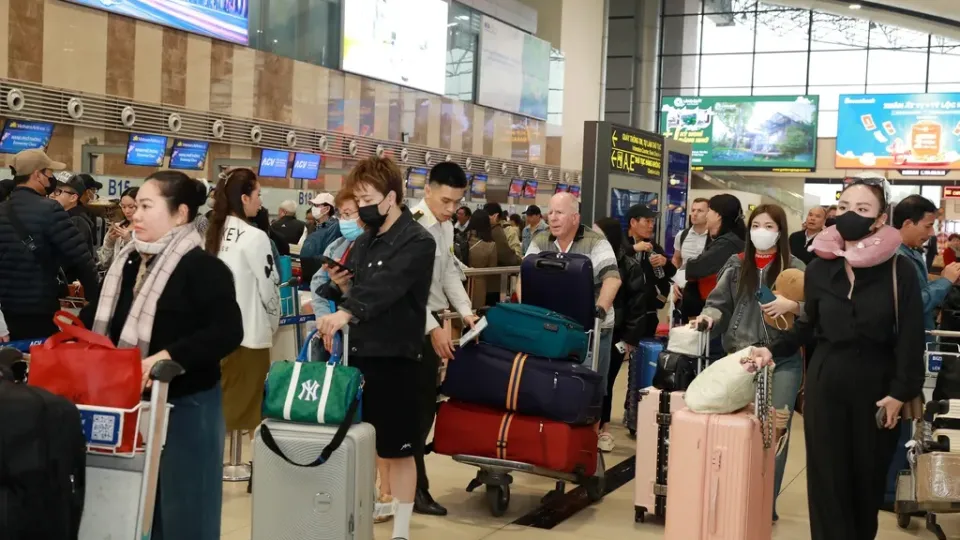
Arya News - The Civil Aviation Authority of Vietnam projected the total number of passengers at 84 million for the full year, up 11.4 percent, and 1.4 million tonnes of cargo, up 18 percent.
HANOI – Việt Nam’s aviation industry is taking off again, showing strong post-pandemic recovery with double-digit growth in passenger numbers and cargo traffic this year, and further expansion expected in 2026, according to the Civil Aviation Authority of Việt Nam (CAAV).
The CAAV’s statistics showed that the industry handled a total of 69.3 million passengers and 1.2 million tonnes of cargo from January to November, representing increases of 10.8 per cent and 18.5 per cent over the same period last year, respectively. Domestic passengers totalled 30.9 million, up 7.4 per cent, while international traffic reached 38.4 million, up 13.6 per cent.
The CAAV projected the total number of passengers at 84 million for the full year, up 11.4 per cent, and 1.4 million tonnes of cargo, up 18 per cent.
CAAV Director Uông Việt Dũng said the robust growth is supported by rising travel demand coupled with increased international cooperation.
The momentum is expected to continue into 2026, Dũng added, with the CAAV forecasting a 13 per cent rise in passenger numbers to 95 million and a 15 per cent increase in cargo volume to 1.6 million tonnes.
The major driver for growth is the stable macro-economy, with GDP growth targeted at 10 per cent or higher next year, which will fuel consumption and tourism.
Regulatory reforms and infrastructure upgrades are also expected to support the sector’s expansion.
Major projects, including the first phase of Long Thành International Airport and upgrades at Gia Bình and Phú Quốc airports, are set to significantly improve the aviation industry’s capacity.
The CAAV said it is necessary to remove bottlenecks in infrastructure development and mechanisms, including policies to accelerate the expansion of major airports to tackle congestion.
In addition, tax and fee incentives should be provided to support the restructuring of airlines and improve their financial capacity, together with further reforms in visa and tourism policies to attract international visitors.
The authority also urged caution over risks such as geopolitical tensions, fuel price volatility, and exchange rate and interest rate fluctuations, which could affect aviation and travel demand.
A recent report by SHS Security projected that with average annual growth of around 5-6 per cent, the aviation market would serve around 150 million passengers by 2035 and 200 million by 2040, up 1.9 times and nearly 2.5 times, respectively, compared with pre-pandemic levels.
Việt Nam currently has 22 airports, including nine international and 13 domestic, with a combined design capacity of 106.5 million passengers per year.
Under the national master plan for airport system development for 2021-30, the country targets 33 airports by 2030, including 14 international and 19 domestic, with a total capacity of 275.9 million passengers and 4.1 million tonnes of cargo throughput per year.